Clean Air for Schools
Results after 4 years of the project
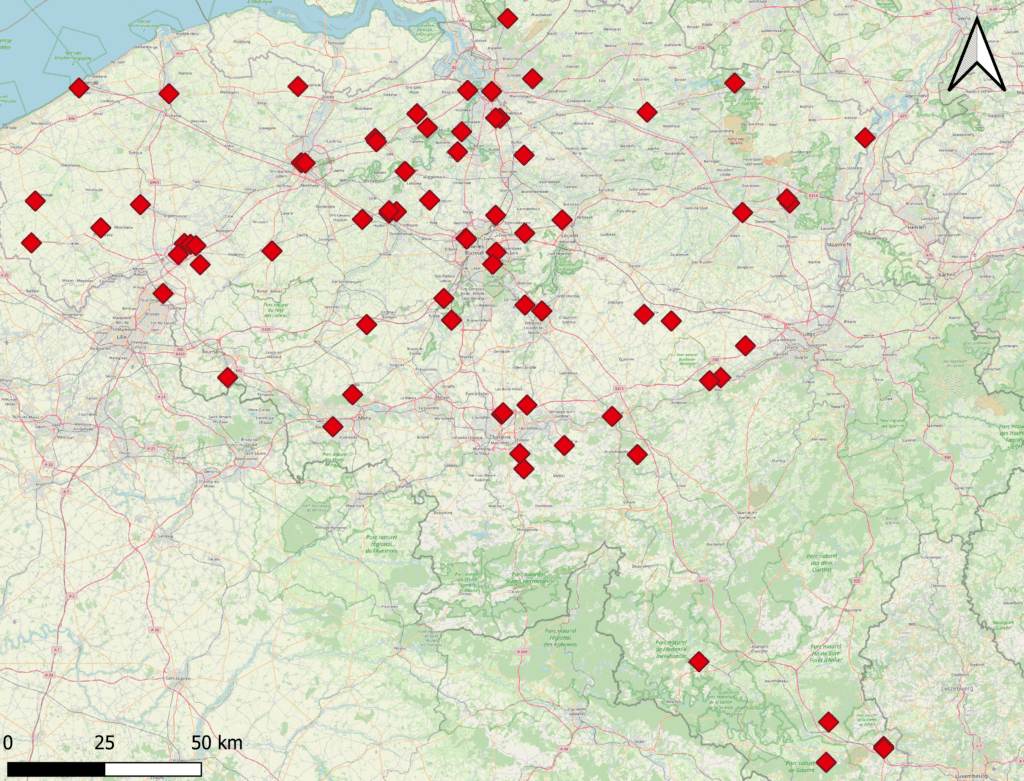
The Clean Air for Schools project stems from an initiative launched in 2020 by Airscan, in cooperation with Belfius. Its aim is to support Belgian schools in improving indoor air quality to protect children’s health and reduce the schools’ carbon footprint. Over three years, 72 schools were equipped and monitored to analyze three main types of pollutants: carbon dioxide (CO₂), fine particulate matter (PM2.5), and volatile organic compounds (VOCs).
Health issues and choice of pollutants to monitor
According to official recommendations, the thresholds used are:
- CO₂: 900 ppm (SPF Belgium)
- PM2.5: 5 µg/m³ (WHO)
- VOCs: 79.6 ppb or 300 μg/m³ (Superior Health Council)
Project methodology
The project begins with the installation of three indoor sensors in different classrooms of each school. An initial assessment is carried out one month later to evaluate the air quality in these spaces.
A presentation is then prepared to inform management, teachers, and prevention committees, and to suggest areas for improvement. These can range from optimizing room ventilation to recommendations related to cleaning schedules and the choice of products used.
A final check is carried out after six months to verify the effectiveness of the measures implemented. The graphs on the left illustrate the percentage of schools that succeeded in reducing indoor air pollution concentrations at the end of the campaign.
CO₂
PM2.5
VOS
Percentage of schools that reduced concentrations between diagnosis and final consultation (in blue)
Compare air quality to recommended thresholds
The graphs on the right illustrate that, in the majority of schools, the average concentrations observed after six months of the campaign remained below the recommended thresholds for carbon dioxide and volatile organic compounds.
More specifically, 67% of establishments comply with the limit values for CO₂ and 55% for VOCs. However, regarding PM2.5 fine particles, only 16% of schools show average concentrations below the threshold of 5 µg/m³.
CO₂
PM2.5
VOS
Percentage of schools with average concentrations below the thresholds for CO2, PM2.5 and VOCs
Limitations of natural ventilation
CO2
PM 2.5
VOS
Average concentrations of the three pollutants measured in the 72 schools.
Clean Air for Schools is the result of a collaboration between Airscan and Belfius. The project, launched in 2020, aims to provide schools with the technological, human and financial resources to improve children’s health and reduce the climate impact of schools.


Solutions to improve air quality in classrooms
The proven effectiveness of ventilation systems
The importance of maintenance
An affordable alternative: air purifiers
For those on a budget, air purifiers offer an effective solution against particulate matter. Successfully tested in a school to reduce PM2.5 levels in a room near the woodworking shop.
Graph showing the percentage decrease in average concentrations in ventilated classrooms for the three pollutants compared to unventilated classrooms.
Conclusive results from the air purifier
Key lessons learned about school air quality
- Particulate matter is the primary concern , more so than CO2 or VOCs.
- Mechanical ventilation systems significantly improve air quality by reducing particles, CO2 and VOCs
- Air purifiers offer proven effectiveness against particles, contributing to healthier indoor air.
Dit staafdiagram toont de fijnstofconcentraties voor en na de installatie van de luchtreiniger in een klaslokaal waar hoge concentraties werden gemeten.